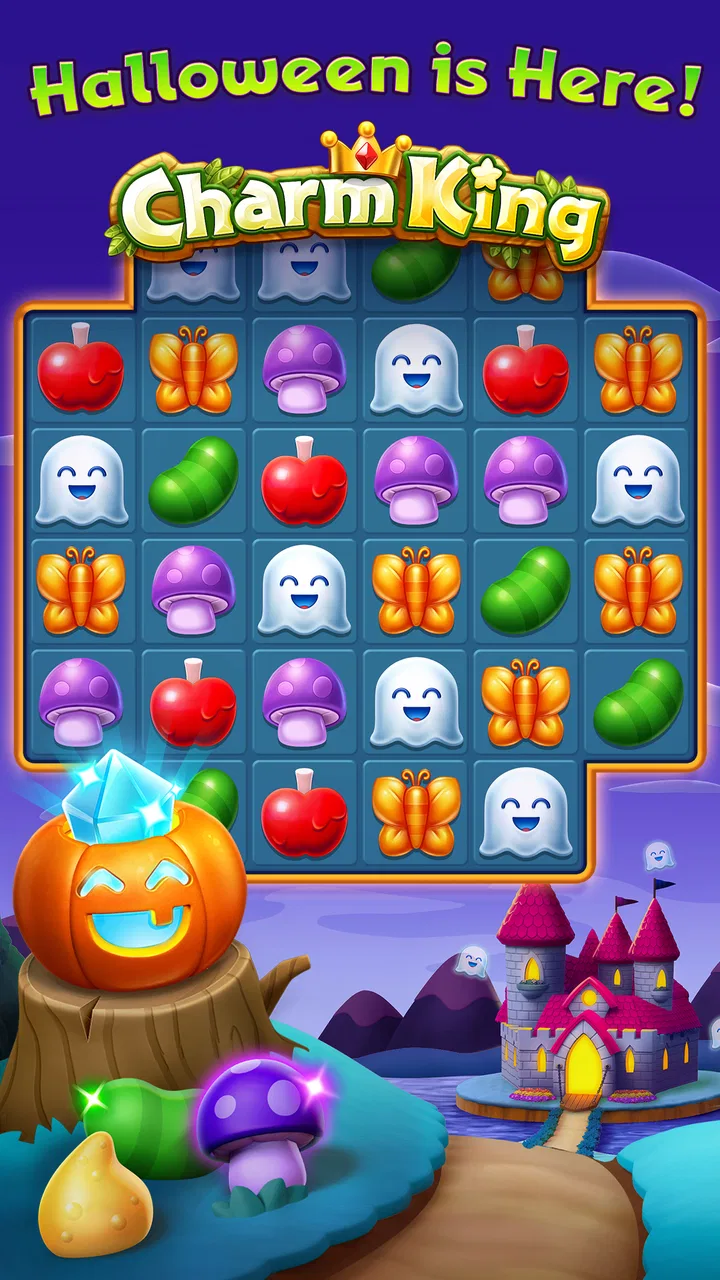
Charm King
- 4.2
- Rating
- 10.00M
- Installs
- Free
- Price

 Analysis by App-foxy
Some match-three games ask for a few spare minutes; Charm King feels more like a small, colorful routine I can return to whenever I want a gentle puzzle break. Its central idea is easy to understand: arrange matching charms, clear the board, and work through a sequence of increasingly demanding levels. I found the appeal less in discovering a complicated system and more in how quickly the game lets me settle into a rhythm.
That simplicity makes it approachable, but it also means the experience depends heavily on how much repetition I enjoy. If you like familiar match-three play with a relaxed presentation, this puzzle game is an easy one to try. If you are looking for a story-heavy adventure, deep strategy, or a competitive game where every move feels radically different, it may feel too conventional.
How the puzzle experience feels in everyday use
Charm King is a free puzzle game from PlayQ Inc, and it is designed around short sessions rather than long explanations. I can open it, understand the board immediately, and begin making matches without spending time learning a complicated control scheme. That makes it useful in ordinary situations: waiting for an appointment, taking a short break from work, or winding down before bed.
You May Also Like

 Blood Strike: 2.5 Anniversary
Blood Strike’s Loadouts Turn Every Drop Into a Tactical Gamble
A close look at Blood Strike’s custom loadouts: how fast access to signature weapons reshapes its battle royale rhythm, rewards preparation, and narrows the gap between fights.

 Pandora - Music & Podcasts
Pandora’s Music Is Easy to Start, but Harder to Recover
Pandora’s strength is its low-effort path from a seed to a station. Its weak spot is how much confidence it asks you to place in connection, setup, and quiet recovery.

 8 Ball Pool
 Is Built on Rivalries, Rematches, and Routine
A close look at the rivalries, rematches, shared routines, and unanswered safety questions that turn a quick pool match into a persistent mobile community.

 Samsung Music
’s Quiet Strength Is Playing What You Already Own
Its reach comes less from spectacle than from dependable access to a personal library. That simplicity is both the app’s strongest retention engine and its ceiling.

 AccuWeather: Weather Radar
AccuWeather Review: A Quick, Clear Forecast for Everyday Decisions
For everyday plans, the best forecast is the one you can understand quickly. AccuWeather makes rain timing, radar, and local conditions easy to act on, with a few trade-offs.

 Hill Climb Racing
Why Hill Climb Racing Still Turns Crashes Into One More Run
A tiny car, a bumpy hill and one more upgrade: Hill Climb Racing keeps resurfacing because its simple chaos makes every near-miss feel personal.
More From Our News Desk
View All News


The best part of this format is the low mental entry cost. I do not need to remember a large inventory, study a map, or coordinate with other players before enjoying a level. The visual goal is always close at hand: look for matching charms, consider the available moves, and choose a useful combination. Even when a level becomes more demanding, the basic interaction remains familiar.
That familiarity is also the first important trade-off. The game does not try to reinvent the match-three formula. Its identity comes from the charm-themed presentation and the way it packages the puzzles into a longer progression. Players who already have several games in this category may recognize the structure quickly. For me, that is a strength when I want something dependable, but a weakness when I want novelty.
The game is rated for Everyone, so it is positioned as accessible rather than mature or intense. I would still treat that label as a general content guide, not as a promise that every level will suit every age or attention span. The colorful design and straightforward rules are friendly, while the need to replay difficult stages can test patience.
What makes the matching feel satisfying
A good match-three board gives me two kinds of decisions. The first is immediate: which match can I make right now? The second is positional: which move leaves the board in a better shape for the next turn? Charm King works best when I resist clearing the first obvious group and instead look for a move that opens more space or creates a stronger chain.
That small pause is one of my practical tips for getting more from the game. I try to scan the lower part of the board before making a move near the top, because changes below can affect what falls into place. I also avoid spending a useful special opportunity simply to clear a harmless group. Saving a powerful move for a blocked area or a difficult objective is usually more valuable than using it for quick visual satisfaction.
Another useful habit is to play with a specific purpose rather than matching randomly. If the board appears crowded, I focus on creating room. If a target is positioned near an edge, I prioritize moves that reach that area. This turns a relaxing game into a light planning exercise without making it feel like a serious strategy title.
There is a subtle difference between playing for a high score and playing to complete a level. A score-focused approach encourages large combinations and stylish clears. A completion-focused approach asks what the board actually requires. I prefer the second approach when a stage is stubborn, because chasing impressive-looking matches can distract me from the objective that matters.
Progression, retries, and the feeling of pressure
The long-term appeal comes from moving through a series of puzzle stages. Progress gives each short session a reason to continue, even when the individual board is familiar. I often find myself thinking, “I will try one more level,” because the next piece of progress is always more immediate than a distant end goal.
That structure can also create pressure. A failed level is not just a single unsuccessful puzzle; after several attempts, it can feel like a barrier between me and the rest of the game. This is where the relaxed promise becomes conditional. The presentation may be calm, but a difficult board can make the session surprisingly tense, especially when I am close to finishing and run out of useful moves.
My advice is to treat retries as information rather than punishment. On the first attempt, I watch how the board behaves and note which area causes trouble. On the next attempt, I change my priorities instead of repeating the same opening. This is particularly helpful when an early move determines whether the rest of the board remains manageable.
Players should also decide how they want to use the game’s free structure. The download costs nothing, but optional purchases are available, ranging from $0.99 to $99.99 for an item. That broad range matters because it means the spending experience can be very different for different users. Someone who never buys anything can approach the game as a free puzzle pastime, while someone tempted by repeated assistance should set a personal limit before difficult stages create frustration.
I would not describe spending as a requirement for enjoying the opening experience. The more relevant question is whether a player is comfortable with optional help becoming part of the routine. If I am tired or impatient, I am more likely to value a shortcut than when I am playing carefully. Setting a rule such as “retry first, consider spending later” helps preserve the puzzle element.
Fairness and what can reasonably be judged
Fairness in a match-three game is not only about whether a level can be completed. It is also about whether the player understands what they are being asked to do, whether failure teaches them something, and whether optional spending changes the nature of the challenge. From my perspective, Charm King is easiest to judge fairly when I separate the puzzle decisions from the purchase decisions.
The core matching loop gives me room to improve through observation. Better scanning, more careful sequencing, and smarter use of opportunities can make a real difference in how a board feels. That is a positive sign for players who want their progress to come from learning rather than simply repeating a button press.
At the same time, the presence of in-app purchases means I would not present the game as a pure test of skill. Optional items can influence how a player handles obstacles, and the listed purchase range is wide enough that spending deserves attention. I do not think every player will experience this pressure equally. A patient player may barely notice it, while a completion-focused player may find it harder to ignore.
For a fair personal test, I recommend playing several sessions without buying anything and asking three simple questions: Am I enjoying the board itself? Do failed attempts reveal a better approach? Do I feel invited to think, or merely encouraged to bypass the problem? Those answers are more useful than assuming that every free-to-play puzzle game feels identical.
The game is also better suited to solo relaxation than to players seeking a transparent competitive environment. I would choose a dedicated head-to-head puzzle game if rankings, live opponents, or clearly defined competitive rules were my main reason for playing. Charm King’s appeal is the personal rhythm of solving and progressing, not proving superiority over another person.
Where it compares well with familiar alternatives
Compared with a minimalist match-three game, Charm King offers a stronger sense of a themed journey. The charm presentation gives the basic act of matching a more recognizable personality than a plain grid with interchangeable symbols. That can make returning to the game feel more inviting, particularly for players who enjoy a little visual character around a simple mechanic.
Compared with a more complex puzzle game, however, it asks less from the player. There is no need to learn a large set of rules before beginning, and the moment-to-moment choices remain readable. I see that as an advantage for casual players and as a limitation for experts who want layered systems, elaborate combinations, or a constantly changing strategic landscape.
It also occupies a middle ground between a completely disposable time-filler and a game that demands daily commitment. I can play briefly and stop without losing the point of the session, but the progression encourages longer-term return visits. That balance is useful for people who want a game available on demand rather than a hobby that takes over their schedule.
The comparison changes if your priority is offline simplicity, complete control over spending, or a one-time purchase. In those cases, I would look toward a premium puzzle alternative instead. Charm King is a better fit for someone who accepts a free download with optional purchases and values an ongoing sequence of approachable boards.
Device expectations and practical details
The game supports operating systems from version 7.0 onward, which makes it available to a broad range of older compatible devices as well as newer ones. I would still keep expectations sensible on an aging phone: a game can be compatible on paper while feeling less comfortable on a small or slower screen. Board visibility matters in a puzzle game, especially when several possible matches are close together.
The current version is 8.15.8, so anyone installing it should use the current store build rather than relying on an old copy kept on a device. Updated versions are generally the sensible choice for stability and compatibility, though I would still check the installation experience on a secondary or older phone before making it a main game.
Its audience is substantial, with more than ten million installs and an average rating of 4.2 from roughly five hundred ten thousand ratings. Those figures suggest that the basic format has broad appeal, but they do not replace personal testing. Match-three games are especially dependent on taste: a high level of familiarity can be comforting to one player and repetitive to another.
The volume of feedback also makes it clear that this is not an obscure experiment. PlayQ Inc has maintained a recognizable puzzle product that many people have tried. I take that as a reason to consider it seriously, not as proof that every design choice will suit me.
Who should try it, and who should skip it
I would recommend Charm King to someone who wants colorful, low-friction puzzles that can be played in short bursts. It is particularly suitable for players who enjoy gradual progression, matching patterns, and the small satisfaction of improving after a failed attempt. It can also work well as a shared casual game in a household where different people want something easy to understand.
A realistic everyday use case would be a ten-minute break during a commute or between errands. I can play one stage, stop before the session becomes a commitment, and return later with the basic objective still clear. That makes it more practical than a game that requires a long uninterrupted run to feel rewarding.
I would skip it if I dislike repeated attempts, become uncomfortable around optional purchases, or want every level to offer a completely new mechanic. I would also choose another category if what I really want is a story, exploration, action, or direct competition. The game can be relaxing, but it cannot turn a familiar match-three structure into something it is not.
Parents and shared-device users may appreciate the Everyone rating and simple controls, while still needing to make their own decision about purchases. The safest approach is to treat the free download and the optional spending as separate choices. The first lets someone sample the game; the second should happen only when the player has already decided that the experience is worth supporting.
My trust verdict after weighing the trade-offs
Charm King earns my recommendation as a straightforward match-three game with an inviting theme and an easy learning curve. I like that it can fit into small gaps in the day and that thoughtful play matters more than frantic tapping. The strongest moments come when I recognize a better board pattern, change my approach, and finally clear a stage that had been resisting me.
My reservation is not about the basic idea; it is about the familiar pressure that can appear when progression and optional purchases meet. Because items can cost from $0.99 up to $99.99, I would play with a clear spending boundary. The game is most enjoyable for me when purchases remain optional in practice, not when frustration makes them feel like the easiest answer.
The large player base and 4.2 average rating show that the formula connects with many people, but the decision still comes down to tolerance for repetition and monetized assistance. I would install it for a calm puzzle break, give the free experience a fair trial, and judge it by whether I am learning from the boards rather than feeling pushed past them.
My final view: choose Charm King for accessible, themed match-three sessions, but approach the optional purchases deliberately. It is a good companion for brief downtime and a reasonable choice for casual puzzle fans. It is not the right pick for someone seeking deep strategic variety, a purchase-free experience, or competition against other players. Knowing that distinction before installing it is what makes the game easier to enjoy on its own terms.
FAQs for Charm King
01What is Charm King and how do you play it?
Charm King is a colorful match-three puzzle game in which you swap adjacent pieces to create lines of three or more matching charms. Completing matches clears the board, while special combinations can produce powerful boosters. Each level has different objectives, such as collecting specific items, removing obstacles, or reaching a target score within a limited number of moves.
02Is Charm King free to download and play?
Charm King can generally be downloaded and played for free on supported Android and iOS devices. However, the game may include optional in-app purchases for extra lives, boosters, coins, or other helpful items. You can progress without spending money, although some challenging levels may encourage you to use resources or wait for lives to recharge.
03Does Charm King require an internet connection?
Many of Charm King’s core puzzle levels may be playable without a constant internet connection, which is useful when traveling or dealing with limited mobile data. Nevertheless, an internet connection may be needed for advertisements, purchases, updates, cloud-related features, events, or synchronization. Availability of offline functions can also depend on the version installed.
04Is Charm King suitable for children?
Charm King uses bright cartoon graphics, simple controls, and easy-to-understand puzzle mechanics, making it accessible to a broad audience, including older children. Parents should still review the game’s age rating and device settings because it may contain advertising, optional purchases, and social or online features. Enabling purchase restrictions is recommended for younger players.
05What are the main advantages and disadvantages of Charm King?
Charm King’s main strengths are its cheerful presentation, straightforward match-three gameplay, variety of level objectives, and satisfying boosters that keep familiar mechanics entertaining. On the other hand, difficulty can become uneven as levels progress, and the limited-lives system may interrupt longer sessions. Optional purchases and advertisements may also affect players who prefer a completely uninterrupted experience.
Pros
- Colorful visuals and cheerful animations make levels enjoyable.
- Simple controls are easy for casual players of all ages.
- Hundreds of levels provide plenty of short gameplay sessions.
- Power-ups help clear difficult board layouts more quickly.
- Works well for quick play sessions without a steep learning curve.
Cons
- Some later levels can feel heavily dependent on luck.
- Limited moves may make certain puzzles frustrating.
- Progress can become slower without spending on extra boosters.
- Repeated match-three mechanics may feel predictable over time.
- Ads and optional purchases can interrupt the overall experience.

Charm King
Gallery